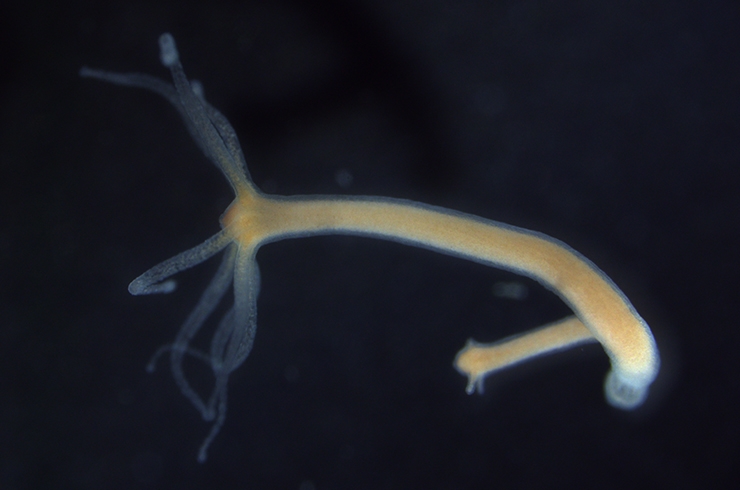
A Hydra individual, with tentacle cells labeled in yellow and foot cells labeled in magenta. Credits: Marylène Bonvin/FMI.
September 24, 2025
The ‘immortal’ Hydra reveals tug-of-war behind cell fate decisions
FMI researchers have uncovered how the freshwater polyp Hydra decides whether a cell becomes part of its stinging tentacles or its anchoring foot, shedding light on some of the fundamental rules of body patterning — or how cells organize into distinct tissues.
Body patterning is fundamental to development, and Hydra — with its simple tube-like body, stinging tentacles and anchoring foot — offers a clear view of this process. Hydra’s immortality, driven by continuous cell renewal, relies on precise, repeated fate decisions, making it an ideal model for studying how cells acquire and maintain their identity.
Working in this tiny freshwater invertebrate, researchers led by Charisios Tsiairis showed that two transcription factors — proteins that bind to DNA and control whether specific genes are turned on or off — engage in a molecular tug-of-war that stabilizes cell identity. One transciption factor called Zic4 drives cells toward tentacle fate, while the other — Gata3 — steers them toward becoming foot cells.
Zic4 and Gata3 mutually inhibit each other in a toggle-like switch, the researchers found. Signals from Hydra’s mouth region tip the balance in favor of Zic4, ensuring proper tentacle development. When either factor is removed, cells flip identities, producing misplaced tentacles or foot structures. However, knocking down both restores balance, revealing the system’s resilience.
The work builds on earlier research from Tsiairis’s team, which showed that Zic4 is essential for tentacle cells. The new discovery that Zic4 and Gata3 form a double-negative feedback loop shows how Hydra coordinates local cell fate with global body polarity.
The researchers also found that cell identity depends on the ratio of these factors, not their absolute levels — a mechanism that may echo across animal development.
In the future, the team plans to investigate the genes controlled by Zic4 and Gata3, as well as the intermediate stages cells pass through before reaching their final identity. By studying how cells go through these transitions, the researchers hope to understand broader principles of cellular decision-making and tissue organization.
Original publication
Jaroslav Ferenc*, Marylène Bonvin*, Panagiotis Papasaikas, Jacqueline Ferralli, Clara Nuninger, & Charisios D. Tsiairis A transcription factor toggle switch determines differentiated epidermal cell identities in Hydra Development (2025)
*co-first authors
A Hydra individual, with tentacle cells labeled in yellow and foot cells labeled in magenta. Credits: Marylène Bonvin/FMI.
About the FMI first author:
Born and raised in Valais, Switzerland, Marylène Bonvin studied biology at the University of Fribourg, where she earned a bachelor’s degree in biology and a master’s degree in animal molecular life sciences. Marylène joined the FMI as a PhD student in 2022. Outside of work, she enjoys skiing, hiking, and running in nature, as well as attending theater performances.