
September 16, 2026
Former FMI group leader Botond Roska receives world’s largest vision award
Botond Roska, a former FMI group leader and now Director of Science at the Institute of Molecular and Clinical Ophthalmology Basel (IOB), has received the 2026 António Champalimaud Vision Award together with ophthalmologist and clinician-scientist José-Alain Sahel. The EUR 1 million prize — the world’s largest award in vision research and ophthalmology — recognizes more than two decades of research aimed at restoring sight.
As announced by the Institute of Molecular and Clinical Ophthalmology Basel (IOB), Roska and Sahel received the Champalimaud Vision Award for their fundamental, translational and clinical research on vision restoration, in particular their work on optogenetic therapies. These approaches seek to restore light sensitivity by making surviving cells in the retina responsive to light after the photoreceptor cells that normally perform this function have been lost to disease. Their long-standing collaboration has helped move discoveries about the workings of retinal circuits towards therapeutic applications. In 2021, Roska, Sahel and their collaborators reported that an optogenetic approach partially restored visual function in a patient with retinitis pigmentosa.
From understanding retinal circuits to restoring vision
An important part of Roska’s research journey took place at the FMI. He joined the institute in 2005 to establish his research group and went on to investigate how different cell types and neuronal circuits in the retina and brain process visual information. His team combined physiological, molecular, viral and computational approaches to understand the retina not simply as a light-sensitive surface, but as a sophisticated neuronal circuit that extracts and processes different features of the visual world before transmitting this information to the brain.
This fundamental understanding also provided a basis for exploring what happens when visual circuits are disrupted by disease — and how their function might be restored. At the FMI, Roska and his collaborators investigated retinal diseases including retinitis pigmentosa and developed experimental gene-therapy and optogenetic strategies to reactivate retinal circuits in models of blindness. His group also uncovered how specific retinal circuits contribute to congenital nystagmus and investigated how visual information is processed beyond the retina, including in the thalamus. The overarching goal was to connect a detailed understanding of the visual system with new ways of treating vision loss.
In 2018, Roska became a founding director of the Institute of Molecular and Clinical Ophthalmology Basel (IOB), where this combination of fundamental and translational vision research continues. The FMI and IOB remain connected, with many IOB researchers having trained or worked at the FMI.
The António Champalimaud Vision Award recognizes the subsequent progress made by Roska, Sahel and their collaborators in translating insights into the visual system into potential therapies for patients. According to IOB, the prize money will support the next phase of their research into new approaches to restoring vision.
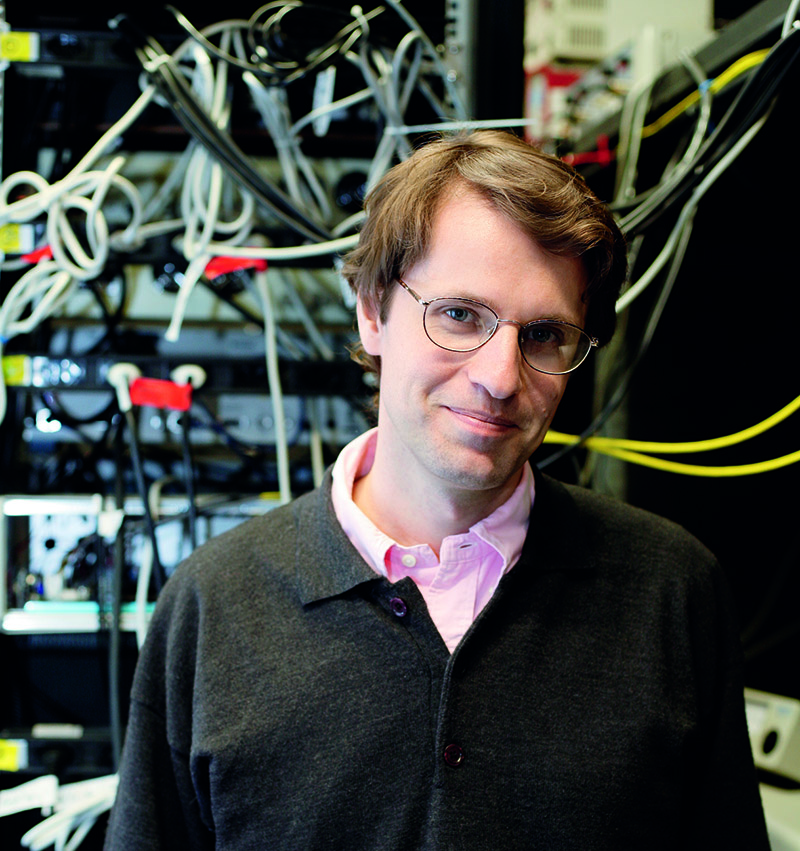 Botond Roska at the FMI in 2006