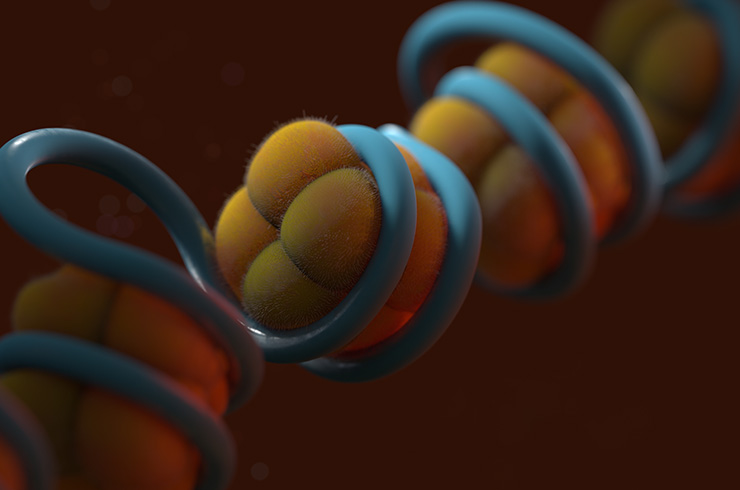
 Transcription factors differ in how strongly chromatin — DNA wrapped around proteins, as shown here — influences where they can bind.
November 23, 2026
How DNA’s surroundings shape gene regulation
FMI researchers found that transcription factors vary along a spectrum in how much their ability to bind DNA depends on the surrounding chromatin environment. The findings point to a more flexible view of gene regulation that could help explain how cells with the same genome activate different sets of genes as they develop and specialize.
Turning genes on and off requires transcription factors — proteins that bind specific stretches of DNA and help control gene activity. But DNA is not laid out bare inside the nucleus. It is wrapped around proteins and folded into chromatin, which can make some regions easier to reach than others.
That means finding the right DNA sequence is not always enough. Whether a transcription factor can bind may also depend on how accessible that stretch of DNA is and on its surrounding genomic environment.
New research from the Schübeler lab suggests that transcription factors vary widely in how much those surroundings matter. Some can bind relatively easily even when DNA is tightly packed, while others are much more dependent on a favorable local environment, with many falling somewhere in between.
The researchers combined measurements of where proteins bind DNA with a machine-learning tool that predicts binding from DNA sequence. This allowed them to tease apart how closely a DNA site matches the sequence a transcription factor prefers, and how much the surrounding DNA affects whether that site is used.
Across the transcription factors studied in mouse and human cells, the importance of that surrounding context varied. Some factors depended on it much more than others, and even the “pioneer factors” studied — which are thought to be especially good at binding DNA when it is tightly packed — were influenced to different degrees by their surroundings.
The findings point to a more flexible view of gene regulation, in which transcription factors fall along a spectrum in how strongly their ability to bind DNA depends on the surrounding chromatin. Understanding that interplay could help explain how cells with the same genome activate different sets of genes as they develop into specialized cell types.
Original publication
Lukas Burger*, Noa Gil & Dirk Schübeler* A quantitative deep-learning-based framework reveals a continuum of chromatin sensitivities across transcription factors Nature Communications (2026)
* co-corresponding authors
Transcription factors differ in how strongly chromatin — DNA wrapped around proteins, as shown here — influences where they can bind.
About the first author
Lukas Burger hails from a small town near Zürich in Switzerland and studied physics at ETH Zürich. After obtaining a PhD in bioinformatics from the University of Basel, Lukas moved to the FMI, where he worked for several years in the computational biology platform led by Michael Stadler. In 2015, Lukas joined the Schübeler group as a senior computational biologist. When he’s not analyzing data, he enjoys reading, playing the piano, and swing dancing.


