October 15, 2025
Video: DNA rhythms orchestrate gene activity across development
FMI scientists discovered that thousands of genes in the worm C. elegans switch on and off in precise, rhythmic patterns during development, coordinated across tissues by chromatin — the DNA-protein complex in the nucleus. Their model predicts these rhythms, showing that chromatin timing drives gene activity and offering insights into human biological clocks.
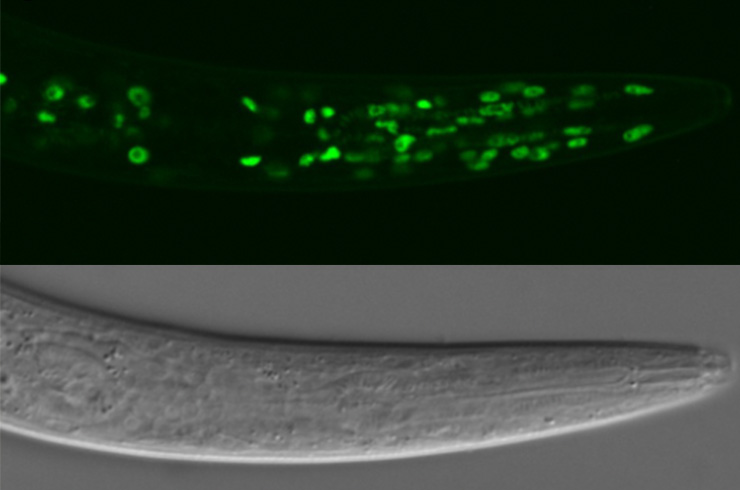
Biological rhythms aren’t just for sleep. In the tiny worm C. elegans, researchers in the Grosshans lab and the Computational Biology Platform have found thousands of genes that turn on and off in precise patterns during development.
This rhythmic activity unfolds like an orchestra, where every gene plays its part at exactly the right moment. These rhythms happen in multiple tissues — skin-like epithelial cells, specialized muscles, and glands — each expressing its own unique set of genes.
Within each tissue, genes peak at different times. This timing ensures every gene acts exactly when it’s needed. Gene activity rhythms are controlled by chromatin — the tightly packed DNA that opens and closes like a gate. This rhythmic chromatin opening precisely matches gene expression cycles.
The researchers built a mathematical model that predicts when and how strongly chromatin opens by using information from just nine transcription factors — proteins that bind DNA and turn genes on or off. Depleting one of these transcription factors in C. elegans confirmed the model’s predictions, showing it accurately forecasts changes in chromatin dynamics and gene expression.
The findings reveal a direct link between chromatin timing and gene rhythms, with potential implications for understanding human biological clocks.
Original publication
Dimos Gaidatzis*^, Maike Graf-Landua*, Stephen P. Methot*, Michaela Wölk, Giovanna Brancati, Yannick P. Hauser, Milou W. M. Meeuse, Smita Nahar, Kathrin Braun, Marit van der Does, Sirisha Aluri, Hubertus Kohler, Sebastien Smallwood & Helge Grosshans^ A scheduler for rhythmic gene expression Mol Syst Biol (2025)
* co-first authors
^ co-corresponding authors
About the FMI first authors:
Dimos Gaidatzis was born and raised in Wettingen, Switzerland. He studied Computer Science at ETH Zurich and did a PhD in Computational Biology at the Biozentrum in Basel. In 2009, Dimos joined the FMI’s Computational Biology Platform as a research associate. Outside of work, he is passionate about music production — from composing orchestral pieces to designing human-machine interfaces for electronic instruments.
Born and raised in Vancouver, Canada, Stephen Methot completed his undergraduate studies in Molecular Biology and Biochemistry at Simon Fraser University in Vancouver, followed by a PhD at McGill University in Montreal. He began his work at the FMI in the lab of Susan Gasser before joining the Grosshans lab. He is the recipient of an Ambizione fellowship, awarded to outstanding early-career researchers. In his free time, he enjoys hiking, rock climbing, and cooking.