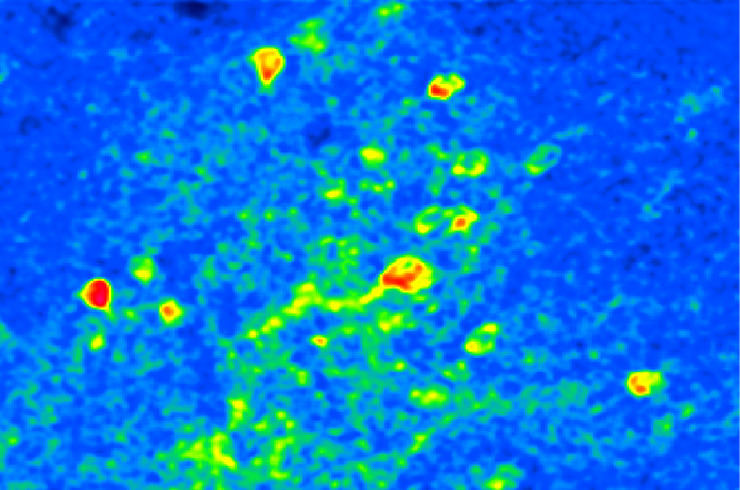
 Neuronal activity in the forebrain of a zebrafish during exposure to an odor, averaged over three seconds. Warmer colors indicate stronger activity. Credits: Hu, Temiz, et al. Nature Neuroscience
September 15, 2026
Learning reshapes the brain’s map of smell
The brain is constantly taking in sights, sounds and smells, and learning helps it decide which ones matter. Working in zebrafish, FMI neuroscientists have found that learning to tell smells apart changed how groups of brain cells responded, making important odors easier for the brain to distinguish. This suggests that the brain may store memories by reshaping the dynamics of activity patterns across many cells, rather than relying on one fixed pattern, so important information is easier to recognize.
Learning can change how the brain organizes sensory information, but researchers are still working out what those changes look like across large groups of neurons. One possibility is that the brain stores a familiar smell as a single, stable pattern of neuronal activity. Another possibility is that patterns are not fixed. Instead, learning changes the range of pattern the brain can produce, making important smells easier to distinguish by reshaping what scientists call the “geometry” of neuronal activity.
To examine these possibilities, researchers led by Rainer Friedrich trained juvenile and adult zebrafish to tell two odors apart—one followed by food and one not. After training, the fish were more likely to swim toward the feeding area when they smelled the odor linked to food, showing that they had learned the association.
The team then measured activity in a brain region thought to form internal representations of the smells in an animal’s environment. The activity pattern varied each time the fish encountered the same odor and quickly faded once the odor was removed, offering little evidence for the hypothesis that odors are encoded by single static patterns.
However, learning did change what neuroscientists call neural manifolds—mathematical descriptions of the different patterns of activity that can occur across many neurons when an odor is present. These can be pictured as clusters on a map: each point represents the combined activity of many brain cells at one moment, and nearby points represent similar patterns encoding the same odor.
These clusters are more complicated than a simple group of dots on a page. They can exist in many dimensions, with the activity of each brain cell adding another dimension, and they can take on complex shapes. To better understand that geometry, Friedrich’s group teamed up with the team of SueYeon Chung, a theoretical neuroscientist at the Flatiron Institute and New York University, now at Harvard, who developed a mathematical framework for studying neural manifolds.
Together, the researchers found that after training, the clusters linked to important odors became easier to tell apart. Similar changes in activity patterns could be reproduced in computer models, and fish with more distinct brain responses were better at distinguishing the odors.
“The findings significantly advance our understanding of what is going on when the brain learns,” Friedrich says. Although researchers do not yet know which changes in the synaptic connections between brain cells produce this reorganization, he adds, the work shows that learning smells may work less like storing each odor in a fixed mental drawer and more like reshaping a map so that important odors stand out.
Original publication
Bo Hu*, Nesibe Z. Temiz*, Chi-Ning Chou, Peter Rupprecht, Claire Meissner-Bernard, Benjamin Titze, SueYeon Chung & Rainer W. Friedrich Representational learning by optimization of neural manifolds in an olfactory memory network Nature Neuroscience (2026)
* co-first authors
Neuronal activity in the forebrain of a zebrafish during exposure to an odor, averaged over three seconds. Warmer colors indicate stronger activity. Credits: Hu, Temiz, et al. Nature Neuroscience


