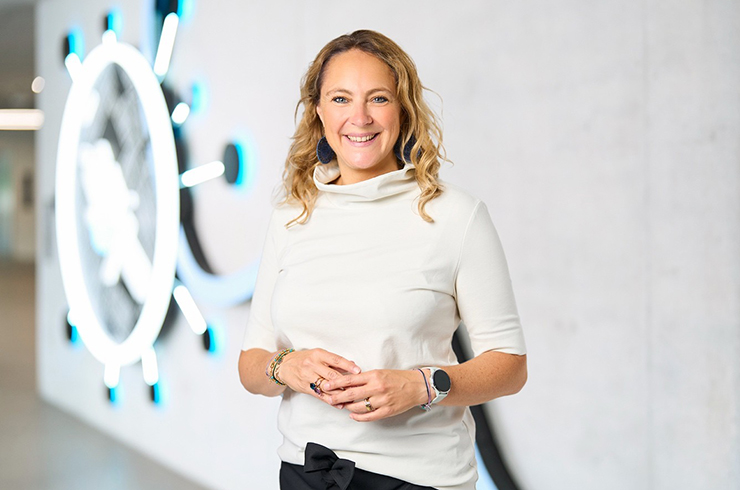
 Prisca Liberali (Credit: Lucia Luca Hunziker / ETH Zurich)
November 26, 2026
Prisca Liberali awarded the 2026 Liliane Bettencourt Prize for Life Sciences
How do cells organize themselves into complex tissues? For her pioneering work addressing this fundamental question in biology, Prisca Liberali, group leader at D-BSSE of ETH Zurich and the FMI, has been awarded the prestigious 2026 Liliane Bettencourt Prize for Life Sciences.
Responsible for evaluating candidates and awarding the Liliane Bettencourt Prize for Life Sciences, the Fondation Bettencourt Schueller's Scientific Council highlighted Prisca Liberali as a standout among an exceptionally strong pool of candidates this year.
The Council praised the scientific excellence of her work, as well as her creativity, ambition and bold scientific vision. According to the Council, her achievements embody the mission of the prize: to recognize researchers who push the boundaries of knowledge and open up new avenues for discovery.
Liberali received her award at a ceremony in Paris on November 25, alongside other laureates honored by the Fondation Bettencourt Schueller.
View Liberali's new page on the Foundation's website, including a video
Understanding how cells build and organize tissues
Liberali's research addresses a fundamental question in biology: how do individual cells coordinate their behavior to build complex, functional tissues? Although cells within a tissue can differ considerably from one another, they work together to generate remarkably organized structures. The Liberali group investigates how this cellular diversity is generated and coordinated, and how interactions between individual cells give rise to collective behaviors and complex tissue structures.
A central focus of her research is self-organization, the process by which complex structures and patterns emerge from interactions between individual components, without every aspect being predetermined. To investigate these processes, her team uses intestinal organoids, miniature, stem-cell-derived models that mimic the intestine and reproduce important aspects of its development and organization. Combining advanced live-cell imaging, high-content screening, single-cell and spatial genomics, biophysical approaches and computational modeling, the group develops quantitative approaches to understand how cellular decisions translate into tissue-level behavior.
This research extends beyond understanding tissue development. The mechanisms that enable cells to organize, adapt and regenerate are central to tissue maintenance and repair, and their disruption can contribute to disease. By uncovering the principles governing multicellular organization, Liberali's work provides important foundations for understanding regeneration, aging and disease, with potential relevance to regenerative medicine.
ABOUT THE PRIZE
Established in 1997 by the Fondation Bettencourt Schueller, the Liliane Bettencourt Prize for Life Sciences recognizes European researchers under the age of 45 for an exceptional scientific career and major contributions to life sciences research. The prize alternates between researchers based in France and those working in other European countries. With a personal award of €100,000, it has honored 32 laureates since its creation.
The selection process is overseen by the Foundation's international Scientific Council. Candidates are assessed on the originality, quality and excellence of their research, their recognition within the scientific community, and the potential of their work to advance human health.
Prisca Liberali (Credit: Lucia Luca Hunziker / ETH Zurich)
“I am deeply honored by this recognition. It acknowledges the dedication of my team and encourages us to continue asking bold questions about how life organizes itself"
Prisca Liberali
About Prisca Liberali
Trained as a chemist, Prisca Liberali completed her PhD in physical chemistry in Italy before pursuing postdoctoral research at ETH Zurich and the University of Zurich. In 2015, she established her research group at the FMI in Basel. She is now a senior group leader at the FMI and Professor of Multicellular Systems at ETH Zurich's Department of Biosystems Science and Engineering (D-BSSE), where she also serves as Deputy Department Chair. Her research has received considerable international recognition, including the EMBO Gold Medal (2022), the Friedrich Miescher Prize (2021), the International Suffrage Science Award for Life Sciences (2024), and the City of Basel Science Prize (2024).


