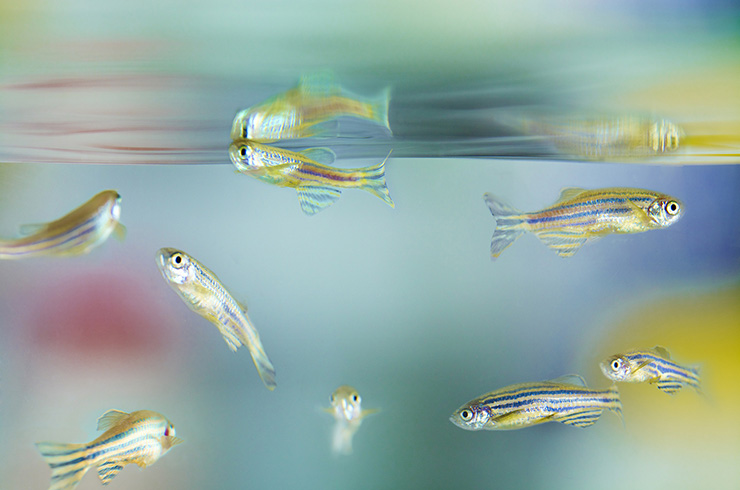
 Zebrafish swimming in a tank. Credits: Novartis
November 5, 2026
Two FMI groups recognized for innovative approaches to animal research
At an internal Novartis event, two FMI labs were recognized for their contributions to the 3Rs (Replace, Reduce and Refine). Rainer Friedrich’s group received a 3Rs Award for establishing zebrafish as an alternative model for neuroscience research, while Anupama Hemalatha’s team received 3Rs Innovation funding for a proposed project using ultrasound to reduce unnecessary animal use.
Animal research remains important in biomedical research when no suitable alternative can address a scientific question. This is also the case at the FMI, where researchers use mice and fish to investigate complex biological processes. Animal research at the FMI is conducted within Switzerland’s strict regulatory framework and guided by the principles of the 3Rs. These principles aim to replace animal experiments wherever possible, reduce the number of animals used when experiments are necessary, and refine procedures to minimise pain, suffering and distress.
For many years, Novartis — the pharmaceutical company associated with the FMI — has organised Biomedical Research Awareness Day (BRAD) for its associates to recognise the contribution of animals to biomedical research and highlight the importance of animal welfare and the 3Rs. Its annual 3Rs Awards recognize contributions in the categories of Replacement, Reduction and Refinement. In addition, the 3R Innovation funding program supports proposed projects designed to contribute to the 3Rs. This year, two FMI teams are among the recipients.
Zebrafish offer new opportunities for neuroscience
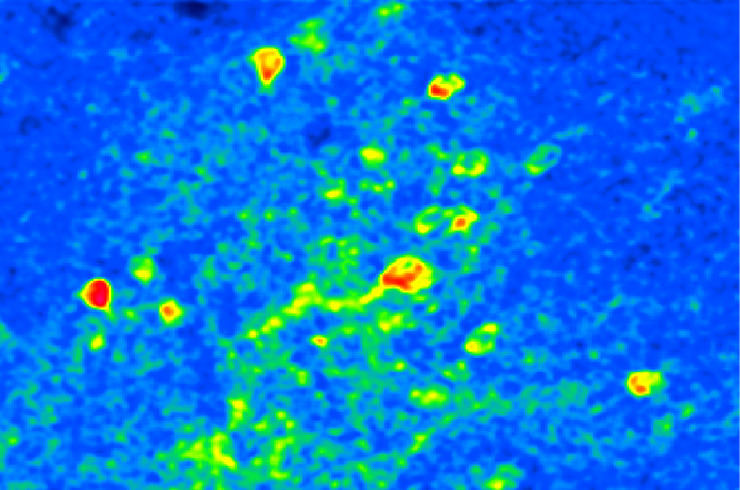
The group of Rainer Friedrich received a Novartis local 3Rs Award for Replacement for establishing adult zebrafish as an alternative model for studying the neural basis of cognition. The team developed imaging methods that record the activity of thousands of neurons in behaving fish without invasive brain surgery, and showed that zebrafish possess neural representations of space, known as cognitive maps, similar to those previously studied in mammals.
The model opens new ways to investigate questions traditionally addressed using rodents, bats or primates. It could replace some experiments involving these animals while also reducing animal numbers and refining procedures by avoiding highly invasive interventions. The 3Rs Basel Working Group who selected the proposal was impressed by the approach’s use of a lower species and the highly informative datasets obtained from individual animals.
Ultrasound to reduce unnecessary animal use
Anupama Hemalatha’s team has received funding through the Novartis 3R Innovation program for a proposed project aimed at reducing unnecessary animal use in developmental biology research. The Hemalatha lab studies how metabolic changes regulate skin development in mice and needs embryos at precisely defined stages. Current methods do not always accurately identify pregnancy or embryo developmental stage, meaning that some animals do not yield embryos suitable for the intended research.
To address this, the team would like to purchase a high-frequency ultrasound imaging system to confirm pregnancy and accurately determine the developmental stage of mouse embryos. This non-invasive approach could allow non-pregnant mice to return to breeding and mice carrying younger embryos to be kept until the required stage. The system could become a shared resource for other developmental biology studies at the FMI.
Advancing research while improving animal welfare
These two projects demonstrate how the 3Rs can be put into practice through the development of alternative research models and improvements to existing experimental methods. More broadly, FMI researchers continue to explore ways of reducing reliance on animal experiments, including the use of organoids — three-dimensional, lab-grown models that replicate aspects of tissues — wherever scientifically suitable. Together, these efforts reflect the FMI’s commitment to conducting high-quality biomedical research while continually improving animal welfare.
Zebrafish swimming in a tank. Credits: Novartis